The search for the robot is a collaboration between RoboHouse and Zentoo, a collective of fifteen chrysanthemum growers. Zentoo asked growers Michel Grootscholten and Jeffrey van Uffelen whether they were interested in this pilot. And they were: Grootscholten: “We have an average of two people per greenhouse of about 10 hectares who work full-time year-round on budding. With this pilot, we want to see if we can solve some of the labour. It is an interesting project, which we started last year.” He looks at the progress with mild criticism. “We haven’t made much progress yet, I think.” He adds laughing: “But yes, we entrepreneurs are impatient by nature; that is our flaw!”
“Making progress,” by the way, is also something they like to do at RoboHouse. But practice can be stubborn. The algorithms to teach the camera to find the right bud require a lot of ‘trial & error’ and thus a lot of time. Moreover, working in the crop is challenging. The lighting conditions are far from ideal. “Our preference actually goes to plants without leaves,” one of the engineers remarks with a sense of understatement. The way in which the bud should be removed is also still under investigation: cutting, clipping, pinching, burning…? There are countless possibilities. An initial experiment with a ‘soft’ laser did not go very well. An ugly brown spot appeared on the plant, and you don’t want that as a grower. A more powerful laser—”one with which you can also cut steel”—works much better. Here, too, the designers cleverly ‘borrowed’ again; this time they drew their inspiration from a device with which growers burn weeds. At RoboHouse, they look at what already exists, but especially at what still needs to come. They teach the robot to better understand which branch has already been budded, so that the robot does not go over the same branch twice. And they create new datasets to find an answer to the fact that chrysanthemum buds keep changing during growth. “Plenty of challenges!” says Mark Bruijnen.
There are, besides RoboHouse, two other parties working on the development of a chrysanthemum robot. Michel Grootscholten follows it with great interest: “It honestly doesn’t matter to me who solves the problem. Where we will buy that machine later is all the same to me. We just want to make good flowers at a good price and with not too much fuss in labour.” Yes, Grootscholten bravely continues with the pilot. When he heard at the end of last year that elsewhere a robot had already left the laboratory stage and was being tested in practice in a chrysanthemum greenhouse, he and Jeffrey van Uffelen briefly considered withdrawing. “But we decided to continue with this. It is not certain to us that those other tests will succeed and be available in time.” What he is especially looking forward to is the coming summer, because then, according to the planning, a prototype should be ready that can be tested in the greenhouse. Will that robot achieve the approximately 7,000 branches per hour that experienced ‘budders’ of flesh and blood achieve in his greenhouse? Grootscholten looks forward to it with great interest!*
Ready for the Future
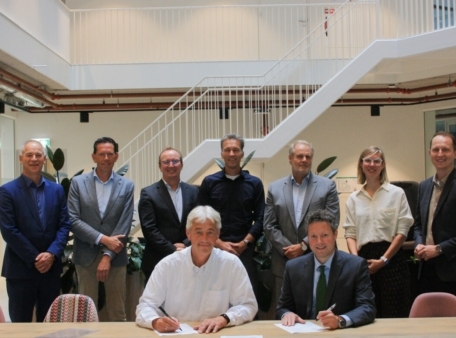
Robots and artificial intelligence (AI) can make companies more efficient, more competitive, and thus more future-proof. Rabobank also has an interest in this and therefore looks for ways to help its customers with this. Since the bank does not have all the knowledge in-house, it works with partners who do. Such as with RoboHouse in Delft. The collaboration between the two is going well, because recently the existing partnership was extended for another three years. Rabobank customers can participate in a RoboHouse Knowledge Cluster (value €5,000) free of charge. This is a series of workshops with experts and people from practice to gain more insight into the possibilities with, among other things, robots. Account manager Gerwien Kerkhof of Rabobank is happy to explain to his horticulture customers that his bank supports various initiatives to help companies become more sustainable and also to save on labor costs. “Some of my customers in Phalaenopsis, for example, recently purchased a stake-inserting robot. Manual staking is labor-intensive, so robotisation is an attractive option.” Besides costs, the availability of labor is also becoming more difficult, Kerkhof hears more and more often. For growers who have ideas or initiatives in this area and want to know what Rabobank can mean for them, he has clear advice: “Call your account manager.”